Anne Lister: the First Modern Lesbian?


Here’s the first in a series of profiles of remarkable lesbians from history that we’ll be publishing once (or more, if time) per month in the run-up to Lesbian History Day on 6th September. Look out for more about Lesbian History Day, what it is, why it exists, and how you can help support and take part in it, which we’ll be writing about for Lesbian Visibility Week later this month.
For now, we’ll leave you in the capable hands of Marie-Helene Tyack as she discusses the remarkable life of “Gentleman Jack” Anne Lister…
I must confess that I didn’t know a lot about Anne Lister until watching “Gentleman Jack” the series starring Suranne Jones – seeing her swagger and speed walk onscreen absolutely fascinated me (nothing to do with Suranne Jones being ever so butch, swoon!).
Anne Lister, often referred to as the “first modern lesbian,” was a woman of remarkable complexity and contradiction. Born on 3rd April 1791, in Halifax, England, she was a landowner, diarist, traveller, and unapologetic trailblazer in a society that sought to confine women to rigid roles.
Her life, immortalised in her detailed diaries, offers a vivid glimpse into the social, cultural, and personal dynamics of 18th and 19th-century England. Lister’s story is one of defiance, ambition, and a relentless pursuit of authenticity in a world that often sought to suppress her.
Anne Lister’s most enduring legacy lies in her diaries, an extraordinary collection of 26 volumes comprising over five million words. Written over 34 years, these journals document her daily life, thoughts, and emotions with meticulous detail. Approximately one-sixth of the diaries were written in a secret code of her own invention, a blend of Greek letters, Latin, mathematical symbols, and zodiac signs. Within these coded passages, Lister chronicled her (many) romantic and sexual relationships with women, as well as her inner struggles and triumphs.
The diaries are a treasure trove of historical insight, shedding light on the social norms, customs, and prejudices of the time. They also reveal Lister’s unapologetic embrace of her sexuality, a rarity in an era when same-sex relationships were not only taboo but criminalised.
Her coded entries, which were so explicit that her descendants considered burning the diaries upon discovering them, stand as a testament to her courage and self-awareness. Famously, “x” in her diary stood for orgasm. She invented terms for her sexual activities (never using any toys, as this would be closer to heterosexual encounters than she wanted) and had a fascination for biology, studying her own genitalia to try to understand what made her “different”.
Lister’s contemporaries often referred to her as “Gentleman Jack,” an unkind nickname that reflected her masculine attire and demeanour. She dressed in black, wore tailored jackets, and carried herself with a confidence and swagger that defied societal expectations of femininity. She also inherited and ran her family’s estate, which was still unusual at the time. Her appearance and behaviour attracted both admiration and ridicule, but Lister remained steadfast in her identity.
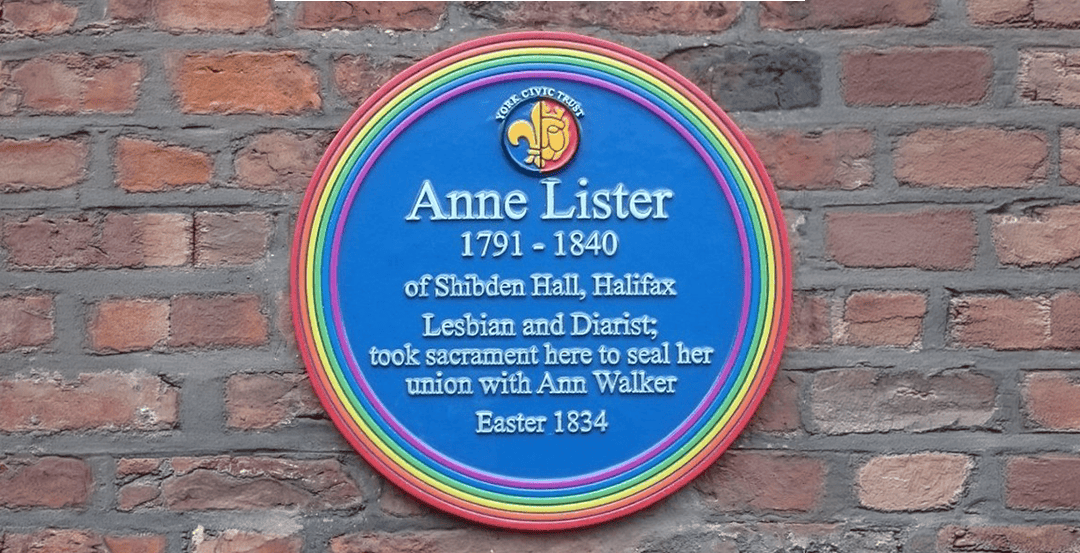
Her relationships were numerous and often tumultuous, but her most enduring partnership was with Ann Walker, a wealthy heiress. On Easter Sunday in 1834, the two women took communion together at Holy Trinity Church in York, a symbolic act that Lister regarded as their marriage.
Though not legally recognised, their union was a bold assertion of their commitment to one another. They lived as equal partners at Shibden Hall – Lister’s family home in Halifax – and both altered their wills to ensure the other’s financial security. Ann Walker moved into Shibden after their marriage and lived there after Anne Lister’s death in September 1840.
Anne Lister was a paradoxical figure, embodying both progressive and conservative ideals. While her approach to gender and sexuality was revolutionary, her political and social views were deeply traditional.
A staunch Tory and successful landowner herself, she believed in the primacy of landowners in governing society and opposed the Reform Bill of 1832, which expanded voting rights to men without property. She harboured disdain for working-class radicals and even evicted tenants who failed to vote in line with her political preferences – something which was possible because in those days, voters had to publicly declare which candidate they voted for until the secret ballot was introduced for parliamentary elections in 1872.
It can be said that she was a bit of a snob and had aspirations of mingling with the higher echelons of society. Most of her conquests were women of a certain social standing, education and financial privilege.
Her religious beliefs were similarly complex. Though she interpreted the teachings of the Church of England to suit her own life and choices, she held traditional views on marriage and was determined to sanctify her union with Ann Walker in a church ceremony. This blend of radical self-determination and adherence to certain societal norms makes Lister a fascinating and multifaceted historical figure.
Lister’s insatiable curiosity extended beyond her personal life. She was an avid reader, a linguist fluent in several languages, and a passionate traveller. Over 15 years, she visited a dozen countries, documenting her experiences in 14 travel journals. She climbed mountains, explored volcanoes, and dined with royalty, driven by a desire to discover new places and escape the confines of Shibden Hall, which she often found cold and oppressive.
Tragically, it was her love of travel that led to her untimely death. In 1840, while journeying through Russia with Ann Walker, Lister contracted a fever, likely from an insect bite. Her final diary entry, dated 11th August 1840, describes the landscape near Kutaisi in present-day Georgia: “High hills north, and, within, ridges of wooded hill rising every now and then into little wooded conical summits.” She died 6 weeks later at the age of just 49. One can only imagine the anguish of Ann Walker, travelling eight weeks back to Shibden alongside Anne Lister’s coffin.
For decades, Anne Lister’s story remained hidden, her diaries untranslated and her life largely forgotten. It was not until 1984 that historian Helena Whitbread fully decoded and published her journals, bringing Lister’s extraordinary life to light. Since then, her story has inspired television adaptations, including the acclaimed series Gentleman Jack, as well as a ballet celebrating her life, currently touring the UK.
Anne Lister’s diaries have earned her the title of the first modern lesbian, a recognition of her unapologetic embrace of her identity and her refusal to conform to societal expectations. Her story is a reminder of the resilience and complexity of those who defy convention, and her legacy continues to inspire and empower.
Anne Lister’s life was one of contradictions, courage, and curiosity. She was a woman ahead of her time, navigating a world that often sought to silence her. Through her diaries, we gain not only a window into her life but also a deeper understanding of the struggles and triumphs of those who dared to live authentically in an era of repression. Her story deserves to be celebrated, remembered, and honoured for the extraordinary individual she was – a pioneer, a writer, a lover, and a trailblazer. I hope I have done her justice in my little way here!
If you enjoyed this article, please consider joining Link for more great insights and events from the LGBTQ+ community


 There Was a Time When I Struggled with the Word ‘Lesbian’