Florence Nightingale: The Lesbian with the Lamp?
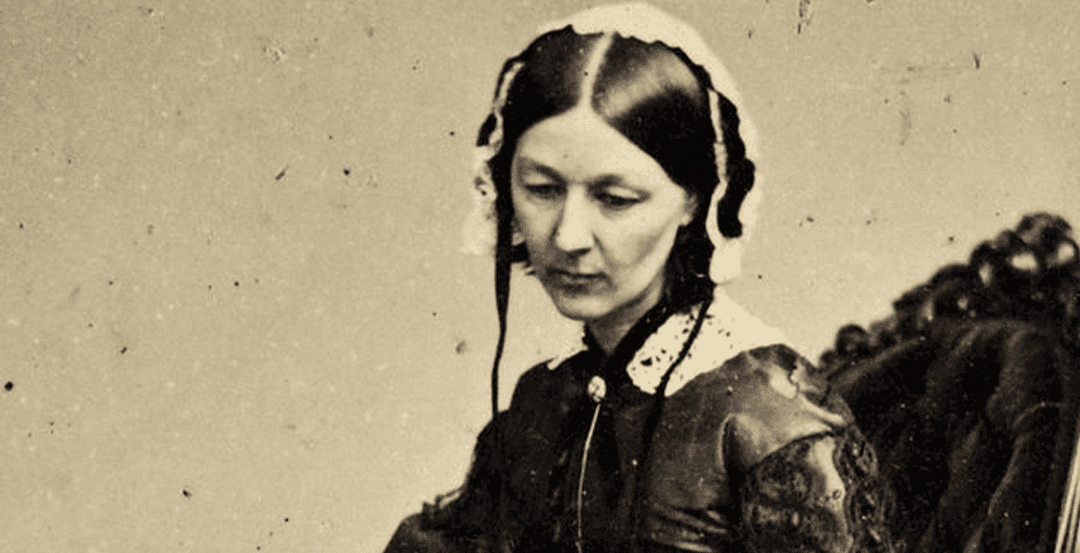


The honest historical answer is that we don’t know.
Like many inquiries into the intimate lives of 19th century women, it is complicated by the language of the period, by the conventions of elite correspondence, and by the fact that modern categories of sexual identity cannot be neatly imposed upon Victorian lives – especially those of women.
For example, the fact that sex between women was never illegal makes it especially difficult for us to day to tell the difference between the “romantic friendships” that were de rigeur in the 19th century and true romantic relationships.
The question of Florence’s sexuality has long intrigued historians of gender and sexuality, though it remains one that resists definitive answer.
Florence was born on 12th May 1820 in Florence, Italy (her namesake) and lived to the grand old age of 90. In many ways, she was set up for greatness early, making it likely that she would achieve something of note.
The Nightingales belonged to the English landed gentry, and her father, progressive for his time, personally supervised her education. She studied mathematics, philosophy, history, literature, and several modern and classical languages, including French, German, Italian, Greek, and Latin.
Such an education was extraordinary for a woman in early 19th century Britain, where upper-class daughters were generally prepared for marriage, social management, and ornamental accomplishments rather than intellectual distinction. (Frankly, an education like this is extraordinary by modern standards too – and a reminder of just how much our parents can shape our future.)
At a time when respectable upper-class women were expected to marry and manage households, Florence came to believe she had been chosen for a higher purpose. In 1837, aged 17, she wrote that God had “called me to His service.”
This sense of vocation increasingly brought her into conflict with her family, particularly her mother, who regarded her daughter’s ambitions as socially inappropriate and personally embarrassing.
Nursing was considered particularly unsuitable for women. Hospitals were dirty, chaotic institutions associated with poverty, drunkenness, and moral disorder. Yet this did nothing to deter Florence. If anything, it spurred her on.
Her most famous work began during the Crimean War, when in 1854 she led a group of nurses at the military hospital at Scutari Barracks. There she confronted appalling sanitary conditions, overcrowding, and preventable disease. She introduced rigorous standards of hygiene, organisation, and data collection that dramatically improved outcomes.
Her nightly rounds through the wards carrying a lamp gave rise to the enduring image of “The Lady with the Lamp.” The phrase derives from a report in The Times, which described her moving silently through the corridors after dark, checking on the wounded.
After the war, Nightingale used statistical evidence to campaign for sweeping sanitary reform in both military and civilian healthcare. In 1860 she founded the Nightingale Training School at St Thomas’ Hospital, establishing nursing as a respected profession, especially for women.
Would Florence have been able to devote herself to her work had she not been from her background? Probably not.
Her social and economic privilege also allowed her to turn down at least four marriage proposals. Her decision was not simply personal but philosophical. She saw Victorian marriage conventions as incompatible with intellectual and professional seriousness for women.
This view found powerful expression in her 1852 essay Cassandra, a searing critique of women’s enforced idleness. There she wrote:
“Why have women passion, intellect, moral activity – these three – and a place in society where no one of the three can be exercised?”
Was this brave, devout and principled woman a lesbian? Certainly, she never married (and one man reportedly attempted to woo her for nine years!).
But the real evidence that suggests she was a lesbian comes from her own words. After returning from Crimea, Florence fell ill and was nursed back to health over several months by an aunt with whom she developed a strong attachment. So strong that in a letter, she described their relationship as “like two lovers.”
Even more indicative, in another letter she wrote of a female cousin, “I have never loved but one person with passion in my life, and that was her.”
More evidence that she had more than friendships with women comes from a line in a different letter to Madame Mohl that states, “I have lived and slept in the same beds with English Countesses and Prussian farm women. No woman has excited passions among women more than I have.” Go Florence, go!
While we can appreciate that language in Victorian England was a little more… flowery… there is absolutely no doubt as to what she meant!
Another comment that is often quoted from her letters has attracted particular scholarly attention. Writing in 1861, she observed: “Women have never excited passion among women unless they have a good deal of what I shall call ‘dash’.”
I hope that she managed to find someone with that “dash”, whatever that meant to her. Answers on a postcard…
For all this speculation, the historical record offers no conclusive answer. However, even if I have failed to persuade you, perhaps you do at least think of Florence Nightingale a little differently.
Here was a woman who lived outside the expected structures of heterosexual domesticity. Who formed profound attachments to women. Who rejected marriage despite repeated opportunities. And who devoted herself to a vocation pursued with near-monastic intensity.
Whether this reflected lesbian desire, asexuality, religious devotion, or some form of emotional life that escapes modern categorisation remains unknowable.
Perhaps the most historically responsible conclusion is also the most interesting: Florence Nightingale’s life reminds us that not every unconventional woman of the 19th century can be neatly classified, and that ambiguity itself is often an important part of the historical record.
(Also, if you want your kids to be extraordinary in life, see that they get an extraordinary – and unconventional – education. Just don’t be surprised if they defy your expectations afterwards.)
Read all about Lesbian History Day, what it is, why it exists, and how you can help support and take part in it. And for more lesbian history, check out this article on “the first modern lesbian”, Anne Lister.
If you enjoyed this article, please consider joining Link for more great insights and events from the LGBTQ+ community


 Renée Vivien – Enigmatic Poetess of the Belle Époque