Renée Vivien – Enigmatic Poetess of the Belle Époque
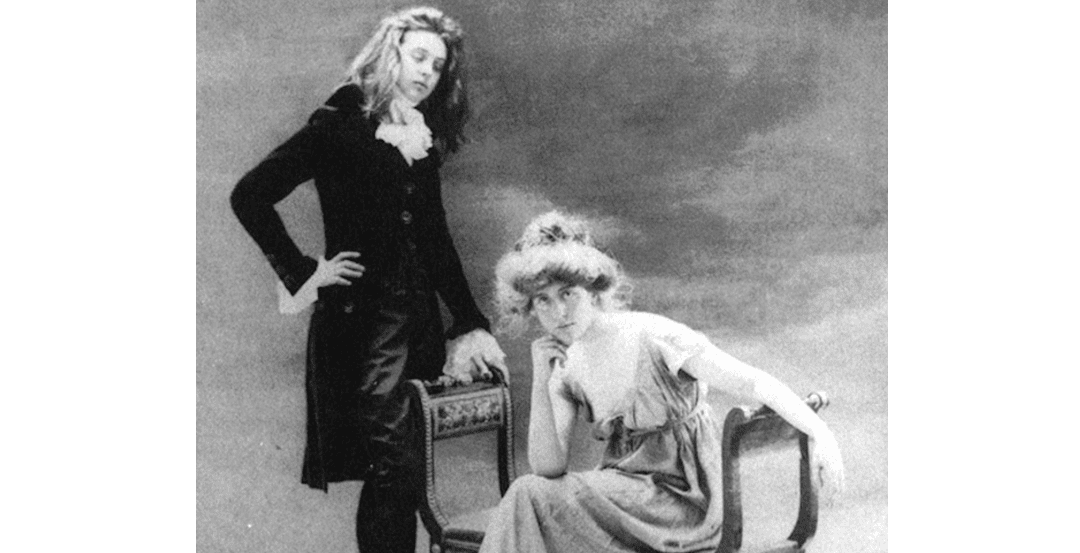


Renée Vivien lived her life as if it were a novel – one filled with passion, heartbreak, and the kind of drama that would make Netflix jealous. Her story is one of love, loss, and literary brilliance, all wrapped up in a whirlwind of champagne, violets, and scandal.
But Renée was not born with that name. She was born Pauline Mary Tarn in 1877 in London, the daughter of a well-to-do English father and American mother. She grew up in Paris until her father died in 1886, when she was shipped back to London.
These teenage years in London were deeply unhappy. Pauline felt French at heart and misunderstood by her English peers. She turned increasingly to literature for comfort, beginning to write French verse from the age of fifteen. At 21 she came into her father’s inheritance and decided to move back to Paris to become a poet.
In 1903 she published her translation and rewritings of Sappho’s poetry under the pseudonym Renée Vivien – Renée meaning “reborn”. In this way, she transformed herself into the Parisienne she always yearned to be, while also making her authorial gender and sexual orientation strikingly, controversially clear.
Renée was unapologetically herself in an era when being openly lesbian was downright scandalous. She didn’t care. She was a woman who loved women, and she made no effort to hide it. Instead, she celebrated it, both in her life and in her poetry.
Her most famous and tumultuous relationship was with Natalie Clifford Barney, the American heiress and literary hostess who was notorious for her charm – and her wandering eye.
When Renée met Natalie in Paris, sparks flew. The two women embarked on a passionate affair that was as poetic as it was chaotic. Natalie, ever the social butterfly, was not exactly the monogamous type, and her flirtations with other women drove Renée to despair. Their relationship was a rollercoaster of love letters, jealousy, and dramatic reconciliations.
But Natalie wasn’t Renée’s only muse. The poet also had a deep and tender relationship with Baroness Hélène de Zuylen, a wealthy married woman who shared Renée’s love of literature. Their affair was more discreet but no less passionate. Hélène even helped Renée publish some of her early work. However, when Hélène eventually chose the safety of her marriage over their love, Renée was once again left heartbroken.
And then there was Kérimé Turkhan Pasha, a Turkish woman who inspired some of Renée’s most haunting poetry. Their relationship was shrouded in mystery, but it’s clear that Kérimé left an indelible mark on the poet’s heart.
In fact, most of Renée’s relationships seemed to end in heartbreak, which, while tragic for her, was a goldmine for her poetry. Everywhere in her œuvre, femininity is celebrated; associated with the moon, the sea, flowers, sensuality, and death.
« Ma bouche a possédé ta bouche féminine / Et mon être a frémi sous tes baisers d’amant » ( « La Double Ambiguïté »)
“My mouth possessed your feminine mouth/And my being quakes beneath your lover’s kisses”
Read all about Lesbian History Day, what it is, why it exists, and how you can help support and take part in it. And for more lesbian history, check out this article on “the first modern lesbian”, Anne Lister – as well as this one on Florence Nightingale – “The Lesbian with the Lamp?”
If you enjoyed this article, please consider joining Link for more great insights and events from the LGBTQ+ community


 Chris Lee on Diversity, Innovation and Customer empathy