“Is it better not to sell any insurance at all?”
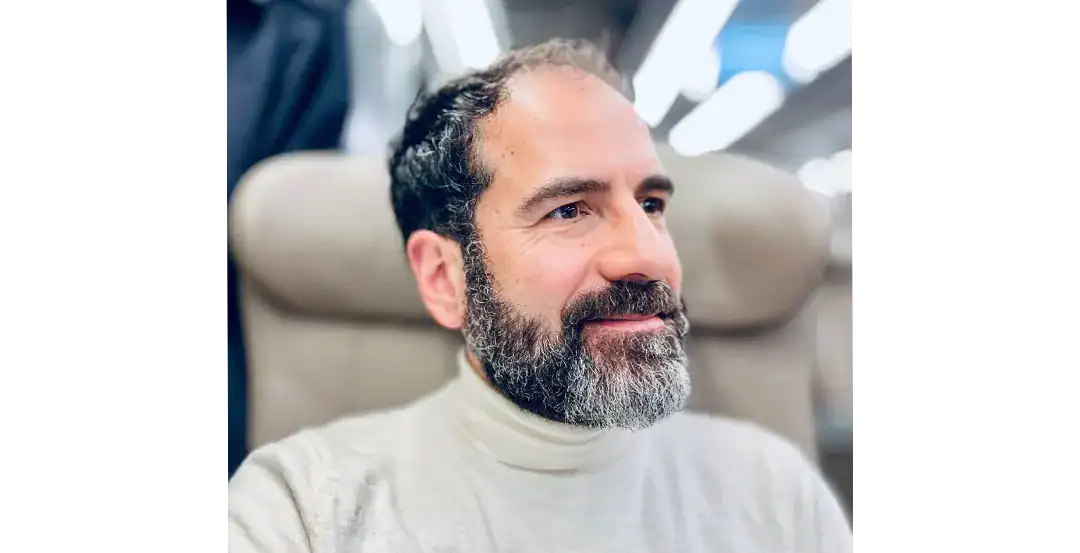


Danilo Raponi, Group Head of Innovation at Generali, built a product for refugees in Germany by starting with their problems and working back from there.
In this Q&A, he explains the mistakes made along the way and why the product was ultimately successful. He also makes the case for applying the same method to the millions across Europe who buy almost no insurance, and for the incentives that would encourage more executives to try – including more diversity in the boardroom.
When you’re looking from an innovation lens, I think it all comes down to companies being unable to focus on the people they are actually meant to serve, yes.
One of the things that large corporates always do still – despite all the preaching that there has been from lean startup, design thinking, and all the other innovation methodologies – is that they always start from solutions rather than problems.
The problem with starting with solutions is that they are made by people who are not representative of the wider population.
So these are technicians, actuaries, people well versed in finance and other disciplines… who also have a certain income, a certain background, so they have different problems and different needs, different expectations than the majority of the population.
This also neglects the purpose of insurance a little, which is pooling risks and ensuring everybody feels safer if they all participate in that pooling. Because in the end insurance is about enabling people to do things, to take risks as well. And the majority providing for the few, in a way, so that whenever something bad happens to someone, this person can feel he or she’s going to be fine, because others in the pool can help fund that.
There’s definitely been a lot of innovation theatre, as we call it. People pretend to be busy innovating, and they go to conferences and set up innovation labs that look like a startup with their cool interiors, and launch hackathons.
All things that theoretically can be helpful. But you need to do them with a concrete goal, with a concrete purpose. If you do them just for the sake of doing them, okay, it’s going to be fun, but in the end, the legacy will be invisible; they won’t have anything to show for it.
What happens typically in an insurance company is that they have charitable foundations. Foundations are obviously great because they donate money to charitable causes. The problem with that is always that it’s a finite amount. So, for example, when I joined Generali, its foundation was already doing great things. But obviously, they have a budget. They can donate, and that’s it.
So the idea was, why don’t we try instead to tackle some of these issues that you are already tackling, but in addition to doing it as a charity, let’s see whether we can build a business around it. The idea was to build a business whose primary purpose is to cover costs, because if you manage to break even, the business can grow, and theoretically the impact is infinitely scalable rather than capped at something.
So that was the idea. We wanted to see what the main issues facing Europe are. This was the time when there were a lot of refugees coming from Ukraine because of the war.
We started there – and this was an important learning, actually, right? – we started trying to approach the groups of refugees directly. It didn’t work very well, because there is an instinctive distrust, I guess, of financial institutions.
We couldn’t successfully do that directly, so we went via NGOs. With NGOs, refugees obviously trust them because they see they help them and have no commercial motives. So we started going via these NGOs and non-profit companies to try to figure out the issues they were facing from, let’s say, a financial point of view.
So they are excluded from everything, and we were like, let’s see whether we can create a bit of a financial inclusion platform that gives access to basic financial tools. And the most compelling problem these groups of people had when they were in Germany – but we also did interviews in France, Italy, and the UK, and it’s more or less the same there – is accommodation.
Because they come into whatever European country, they are provided accommodation for a while by the government, but after around six months – more or less depending on the country – they need to leave government accommodation and go into the private market.
Even though they may get subsidies from the government, the problem of going into the private market is that a combination of racism and other issues makes it very difficult for them to secure private accommodation. Landlords are often very reluctant.
So we’re like, how can we help them there? And we said, okay, the name of Generali and its financial strength might help persuade some of the landlords to give them accommodation if we guarantee the rent and the deposit.
Thus the first product that we launched was a rental guarantee on the deposit, which made it much easier for them to secure accommodation. In many cases, we signed agreements with landlord associations across Germany to facilitate that.
Yeah, for sure… This is one thing I think insurers have been neglecting. And this is, I think, where we can probably find a convergence between doing good and also enlarging the pool of company profits.
On one hand, they tend to consider the protection gap only in developing countries, overlooking the significant gap that exists in developed nations as well. Consequently, many people in Europe buy only the minimum cover, such as third-party liability in motor insurance, because it’s mandatory, without purchasing additional policies. This leaves them vulnerable to various risks.
Just think about private liability. A lot of people don’t have private liability cover, so they could theoretically be liable for accidental damage. I mean, it’s a very extreme example, but you could be liable for millions and millions. And this cover only costs like 50 pounds a year or something, so it’s something a lot of people can actually afford.
There are a couple of problems with how insurance is perceived. Insurance is seen as so problematic partly because it’s obscure – all these contracts with 40 pages of terms and conditions – and partly because once you need to claim, then it’s a mess. It takes ages, or they might try to reject the claims.
So if insurance companies want to grow in developed countries rather than just in developing countries, they need to really think about this protection gap seriously. Why are there so many people in Europe who have almost no insurance coverage?
Some of it is due to the fact that insurance is extremely badly perceived. Others, though, is that a large part of the population is currently excluded from insurance because these products are not designed for them. They are designed for middle-class to upper-class people who can afford it and care about the benefits.
I believe efforts should focus on two main areas: first, making insurance significantly easier to understand, clearer, and more accessible.
I would like to think that nowadays with AI, it’s going to be even easier to detect fraud. So if we… if we detect real fraud more easily I think we can make insurance a little bit kinder, in the sense that if you have a claim which is in a grey zone, you think it should really be paid, but the insurance company thinks rather not, because it’s unclear, then the insurance company can say, you know what, you haven’t claimed in five years, and even if I think this claim actually probably shouldn’t be paid, I’ll pay it anyway, right?
The second thing they should be working on is making insurance more available and more affordable for this population that is now excluded from it.
You obviously should skim a little of the profit margin as well, but then people say, oh, why should we do that? Well… do you want to access that market or not? If you don’t do that, you will never be able to win over this very large portion of the population that doesn’t buy insurance.
Is it better not to sell any insurance at all? Or to compromise a little bit on the profit of each one for potentially very high volumes?
This is a super important point. I think the core of the problem lies there because as long as we do not have any diversity among the people making these decisions, we’re not going to have any real innovation.
If you think about it, if you are a group of middle-aged – or even older – well-off men, you don’t instinctively think about the Sikh community, or refugees, or the migrants. You just think about doing the same thing that you’ve been doing in the last 30 years, and try to do it maybe better.
At the moment, what I see in large companies is that it’s a bit like innovation. They talk a lot about diversity. They have all sorts of programmes and training and whatever about the importance of diversity. But that doesn’t translate into anything, really. Not yet, at least.
Because then you have diversity at all levels in the company except the people who make the decisions.
It’s very complicated, and I definitely don’t have a definite answer.
I think there has to be a base of diversity. Diversity really has to be spread throughout the company, at all levels, and has to be recognised by people who belong to more traditional groups, right?
Actually, most of the time, it’s important that, let’s say, white heterosexual men champion diversity, because they’re still the majority most of the time, so if they oppose it, that’s a problem. But I think the coalition is important, because otherwise the diverse voices don’t get listened to.
I think if we manage to get to a point at which some people – maybe silently – make it to the board, and then once they are there, they see that there is a strong base of diversity in the company, they feel more entitled, they feel more protected to act…
In a way, it’s a bit like a politician. If they know they’ll have support for a certain set of policies, they’ll be more vocal about it, rather than if they think their policies will only be liked by a minority.
At the moment, the situation is still like that, because even though I see more diversity in the companies I work with, directly or indirectly, I still feel the majority would resist a board member being very vocal about it.
Yes, because however powerful one person may be, if everyone else is against them, then there’s not much you can do.
It goes back to a lot of things we discussed, right? Beyond the profit margin, I think you can make a strong case nowadays for building things that have an impact on how the company is seen.
And if you can prove that by doing some good, you are also improving the reputation of the company, then I think that has a much better chance of succeeding.
This is an abridged version of a much longer conversation Danilo had with our head of comms, Damien Seaman. Click here to read the full, uncut Q&A.
 https://www.lgbtinsurancenetwork.com/wp-content/uploads/2026/10/Danilo-Raponi-Featured-image.webp
1080
1080
fletch
https://www.lgbtinsurancenetwork.com/wp-content/uploads/2021/03/Link-LGBTQ-Insurance-Network-logo-web-white.png
fletch2026-10-22 08:51:162026-10-22 08:51:16Danilo Raponi on building insurance for people the market typically overlooks
 https://www.lgbtinsurancenetwork.com/wp-content/uploads/2026/09/Louis-Stevenson-Featured.webp
1080
1080
fletch
https://www.lgbtinsurancenetwork.com/wp-content/uploads/2021/03/Link-LGBTQ-Insurance-Network-logo-web-white.png
fletch2026-09-29 06:00:392026-10-22 08:52:38Progress Has Not Removed the Need for Visibility
 https://www.lgbtinsurancenetwork.com/wp-content/uploads/2026/09/Daniel-Perez-Featured.webp
1080
1080
fletch
https://www.lgbtinsurancenetwork.com/wp-content/uploads/2021/03/Link-LGBTQ-Insurance-Network-logo-web-white.png
fletch2026-09-23 06:00:052026-10-22 08:52:21This is How We Build a Stronger, More Sustainable Workforce
Click below to apply to take part in this diversity article series and be interviewed yourself…
Diversity & Innovation: Perspectives from insurance industry leaders at Insurtech Insights Europe, 2026
If you enjoyed this article, please consider joining Link for more great insights and events from the LGBTQ+ community


