“I’m Glad I Didn’t Start in the City!”
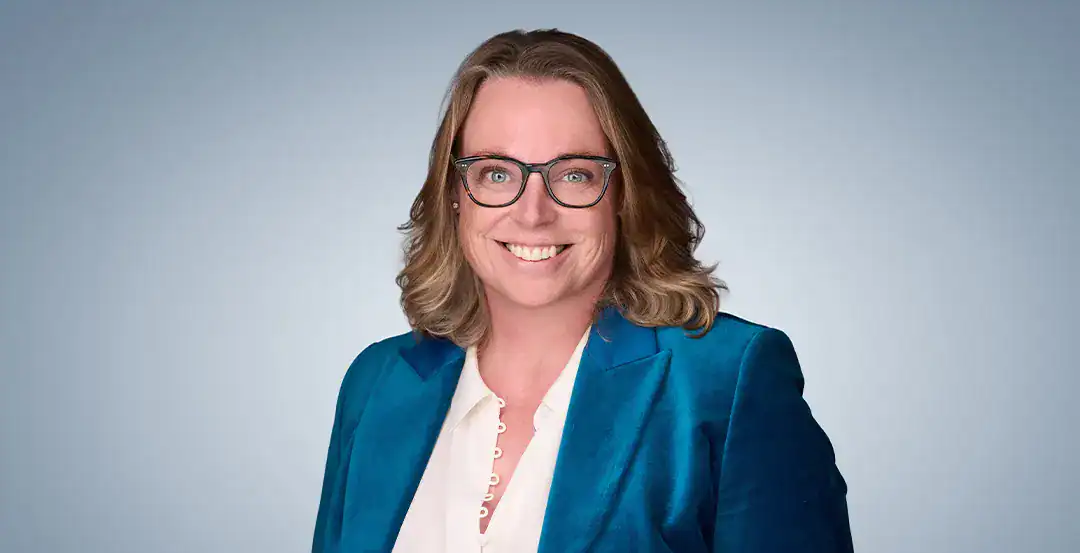


First female manager in Allianz’s London office in 1999. First woman on the HDI Global SE executive board, 2022 (and first non-German). First female chair of the International Underwriting Association…. Claire McDonald’s CV reads like a long list of “first woman to’s.” And yet she had to fight to get one of her earliest key management roles. So much so that her former boss was sheepish about it even years later.
It was the early 2000s. Claire had recently become her office’s first female manager. Then the opportunity came up for her to move into a more senior position after months of pushing for it. Eventually, she got it. Years later, she bumped into her old manager in Munich Airport.
“One of my biggest regrets was not giving you that job earlier. We would have made a lot more money,” he admitted. “But you were young, and you were a woman.”
This, in a nutshell, is what ambitious women faced in insurance 25 years ago. A culture built on traditional relationship-building and a heap of assumptions about what clients would find acceptable.
“And when I took that job, I had to do it on the basis that I didn’t get pregnant for two years!” Claire adds.
So, how much has this culture changed?
For Claire, times have clearly moved on. There is much more diversity in the City – not least with more visible women in key management roles. And yet archaic attitudes and undermining behaviours remain, and Claire says she’s disappointed in some of the stories she hears.
She also believes that the traditional relationship-building aspects of the industry are one reason why barriers remain for women and other under-represented groups. To her, it’s often been a way to exclude those not in the boys’ club.
“I think there’s a place for relationships within any profession, and ours is an unusual ecosystem – outside of banking I’m not sure there are too many professions where the product is delivered through syndication. But I don’t think it should be that the people that get on in it are the ones who’ve got a network, or because someone’s giving you a leg up. It should be a meritocracy and what you achieve in the office.”
Speaking on the eve of the 2026 Lloyd’s Underwriting Talent Summit – which seeks to address how to get more women in senior leadership roles – Claire is blunt when I ask her why there aren’t more senior female underwriters.
Of course, it’s important to recognise that things have improved for women. For example, Claire says it’s no longer the case that managers worry about male brokers giving less business to a woman, as they did when she was given a job in 2002: “The thinking was: if the typical male broker didn’t like dealing with a woman, we’re going to lose business by putting a woman in the job. And actually what they discovered was they didn’t lose any business at all. It was probably cheaper on the T&E, because the brokers didn’t like the women paying for them at lunch.”
But now?
“I don’t want to say this, but I’m going to say it anyway…” she says. “I don’t want to say it because I don’t want it to be true. But my feeling is – and whether it’s historical and going forward it’ll be different – that fewer women have wanted it, and the aggro that sometimes comes with it. I think there’s a perception also with these sorts of jobs that politics come with it, other things come with it, which aren’t particularly attractive to a lot of women. Or they see somebody in that job doing it a certain way and think, well, I can’t do the job like that or I can’t do those hours.”
Organisations can make it harder or easier, she adds, by the extent to which their culture is welcoming and receptive to the need for personal and professional growth – the extent to which they are prepared to invest in women to help develop their confidence.
“But I do think, for the senior-level jobs, there’s got to be a bit of hunger. Very rarely will someone come and say, ‘Oh, please do this job, I’m begging you to do this job.’ It might happen occasionally, but it’s not the norm. So you’ve either got to have said, ‘I fancy the progression, I fancy doing that,’ or ‘I would love to be that one day,’ or ‘I would like to be on the succession.’ I think there’s an awful lot of women that don’t express that. And if you want it and you don’t say it, well, that’s just as unhelpful as not wanting it.”
She’s often seen talented women fall by the wayside and not go for jobs Claire thought they’d be great for. “And I’ve had quite a few conversations and said, ‘Why aren’t you applying for this?’ And they’d be like, ‘Well, I haven’t got this, that and the other.’ And I said, ‘Just apply.’ And they’ve got the job.”
This leads us to Claire’s approach to hiring for diversity, which is to ignore what she calls a person’s “packaging” – to look through to the person within, regardless of race, gender, sexuality or religion.
“For me, these women were sharp, they had good ideas, they were sparkly-eyed, and I could see the energy they could bring. So those criteria have meant, I suppose, that I’ve tried to be packaging-agnostic. It’s very much a third or fourth factor down the line. That means I’ve appointed men just as much as I’ve appointed women. And unless somebody tells me, their sexuality is not going to come up. Do I care anyway? No.”
She hires for sparkly eyes and challenge, not characteristics, because she’s looking to avoid building echo chambers of people who all think the same way. Do that, and the outward diversity follows.
But isn’t a team that contains people with more diverse characteristics likely to have greater diversity of thought?
“I think so,” Claire replies, “because there are certain life experiences that come with some of this packaging. Whether you’re an ethnic minority, whether you’re gay, whether you’re female to a certain extent – there is a set of life situations you would have dealt with that the straight white bloke, if you’re talking in a Western European context, has probably got no idea about.”
She offers a particularly vivid example: “I would say to anyone managing people in their fifties, if they’re seeing issues with performance or people (men and women) are perhaps not as sharp as they were – somehow you’ve got to help some self-care prioritisation where hormones and bloods get tested. From my own experience I thought I was moving through my ‘second spring’ happily until the day I wasn’t, followed up with testing and was able to get medication to bring me back. This happens to both men and women and something we can all do a better job to be conscious of.”
In short, having people with a range of experiences in a people-centric business is a good idea, because “we can help drive performance by showing people there are other people out there who’ve been through the same thing and might have a helpful perspective.”
Different perspectives are also useful in the context of innovating new products or processes.
“When it comes to workshops where you’re looking to be creative – first of all, it’s much more fun if you’ve got different opinions in the room. For me the fun is that I don’t know the direction it’s going to go,” Claire says.
“If you work things through as a group, you’re capable of doing more than as a single individual. But you’re not going to have the same benefit if all the people in the group think the same way or have the same life experience.”
But by far the biggest benefit to diversity Claire sees is less around innovation and more around risk management.
“We’ve seen various financial crises, and the role that homogeneity plays in the non-identification of risk. I think a more diverse team is more likely to assess or pick up risk at an earlier point.”
If you have different people with different inputs, “one and one should equal more than two” because the group sees more than any individual could. If everyone is the same, “one and one probably equals one and a half” – the group adds less than the sum of its parts, because they’re all looking at the same thing from the same angle.
That said, “If you hire diverse minds, you then have to create the conditions in which they can actually thrive – speak-up culture, psychological safety. There’s no point having a group of diversely minded people and then not asking them for a view. You need to make sure the environment you create gives them room to contribute in the way they want to.”
And that’s probably easier on the innovation side than on the risk side, Claire believes, because when it comes to risk, “nobody wants to be the one that puts their hand up and asks questions when everybody else is drinking the ‘Kool-Aid’.”
Making a room feel safe enough for all people to participate is key to Claire’s outlook on how workshops should operate.
“A workshop or a meeting is participants required, not audience. I try to take any hierarchy out of those meetings. With offsites, I’d always bring in a couple of wild cards — the next level down, a bit of talent you’re looking at. And sometimes you have to be explicit: ‘My voice doesn’t count for any more than anyone else’s voice.’”
And she insists on tracking psychological safety, using the Amy Edmondson checklist: “Every time we have an offsite, we look at whether people feel it’s better or worse than last time. Because that sucked, frankly, when I was 22 and I didn’t get invited to participate because I was the wrong grade.”
Psychological safety goes out the window in any team or organisation if poor behaviour goes unpunished. Claire knows what that looks like, because she’s had to deal with the results of it multiple times in her management career.
“I’ve had quite a few crying women in my office over the years that are at a point of complete and utter ‘I’m up to here’ with their office environment. Quite often that will be a toxic environment, where exaggerated comments are being made about behaviour, or about clothing, or about what they’re doing or not doing, and none of it is appropriate. Sometimes if you’re stuck in those environments, you have to realise that you’re the one that has to leave — because you as an individual are never going to change the culture of an organisation.”
This is where a good leader makes all the different to a company culture, and she herself has had no hesitation about laying down what she will and won’t put up with.
“When I went into one of my previous roles, my first opening speech, I set out what my values were and what my expectations were, and that I expect everybody to come to work and be respected at work. One week later, I got told of something that resulted in somebody being let go. Six months later, I got another one. After that I didn’t get any more.”
She adds: “People don’t come forward unless they feel it’s actually going to be taken seriously. Both of those incidents predated me, but they obviously felt they could trust me to act on it. There was no distinguishing whether or not you brought business into the organisation. For me, that’s part of being fit and proper as a leader.”
Reflecting on her start in insurance, she muses that she was lucky to start her insurance career as an 18-year-old in a Maidstone branch of Cornhill UK.
“I’m glad I didn’t start in the City, because the regional offices were a lot more 50/50 men and women… I was working with a lot of women who were clearly responsible for what they did. Then I moved into commercial and was put with a team leader who was female, Sandra. So my second ever manager was female.”
Having these mentors and role models clearly stayed with her, because mentoring new talent gives her enormous pleasure.
She tells the story of a boy she was paired with through a school mentoring programme when he was 16, so green he got lost on the way to her office because he didn’t know which exit to take at Bank.
Claire did some interview practice with him, told him Allianz had jobs going, and got him in front of the right people. He did the rest. Last week, she bumped into him in the street: “And he’s still there ten years later and thriving. That for me was a big kick for the day!”
Which is, in the end, her whole philosophy: insurance is about people, and the job of a leader is to build a place where they can do their best work and be themselves while they do it.
“It shouldn’t be difficult, should it? It shouldn’t be difficult to come to work and be able to do a good job. You come into an environment that wants to help you learn, that wants you to be the best that you can be, and equally the company gets something in return. It should always be a win-win.”
 https://www.lgbtinsurancenetwork.com/wp-content/uploads/2026/11/Scor-Business-Solutions-CEO-Claire-McDonald-Featured.webp
1080
1080
fletch
https://www.lgbtinsurancenetwork.com/wp-content/uploads/2021/03/Link-LGBTQ-Insurance-Network-logo-web-white.png
fletch2026-11-10 06:00:052026-11-10 15:22:15“I’m Glad I Didn’t Start in the City!”
 https://www.lgbtinsurancenetwork.com/wp-content/uploads/2026/11/Bethany-Thomas-Allianz-Featured.webp
1080
1080
fletch
https://www.lgbtinsurancenetwork.com/wp-content/uploads/2021/03/Link-LGBTQ-Insurance-Network-logo-web-white.png
fletch2026-11-09 06:00:492026-11-09 16:31:49Allianz UK’s Head of Sustainability: Diversity Isn’t a Nice to Have. It’s the Only Way
 https://www.lgbtinsurancenetwork.com/wp-content/uploads/2026/10/MS-Amlin-Gemma-Lines-Featured-Image.webp
1080
1080
fletch
https://www.lgbtinsurancenetwork.com/wp-content/uploads/2021/03/Link-LGBTQ-Insurance-Network-logo-web-white.png
fletch2026-10-27 09:15:462026-10-27 09:15:46MS Amlin’s Chief People Officer on why hiring for diversity is the (relatively) easy part
 https://www.lgbtinsurancenetwork.com/wp-content/uploads/2026/10/Danilo-Raponi-Featured-image.webp
1080
1080
fletch
https://www.lgbtinsurancenetwork.com/wp-content/uploads/2021/03/Link-LGBTQ-Insurance-Network-logo-web-white.png
fletch2026-10-22 08:51:162026-10-22 08:51:16Danilo Raponi on building insurance for people the market typically overlooks
 https://www.lgbtinsurancenetwork.com/wp-content/uploads/2026/09/Louis-Stevenson-Featured.webp
1080
1080
fletch
https://www.lgbtinsurancenetwork.com/wp-content/uploads/2021/03/Link-LGBTQ-Insurance-Network-logo-web-white.png
fletch2026-09-29 06:00:392026-10-22 08:52:38Progress Has Not Removed the Need for Visibility
 https://www.lgbtinsurancenetwork.com/wp-content/uploads/2026/09/Daniel-Perez-Featured.webp
1080
1080
fletch
https://www.lgbtinsurancenetwork.com/wp-content/uploads/2021/03/Link-LGBTQ-Insurance-Network-logo-web-white.png
fletch2026-09-23 06:00:052026-10-22 08:52:21This is How We Build a Stronger, More Sustainable Workforce
Click below to apply to take part in this diversity article series and be interviewed yourself…
Diversity & Innovation: Perspectives from insurance industry leaders at Insurtech Insights Europe, 2026
If you enjoyed this article, please consider joining Link for more great insights and events from the LGBTQ+ community


