Jane Addams: The Most Dangerous Woman in America?
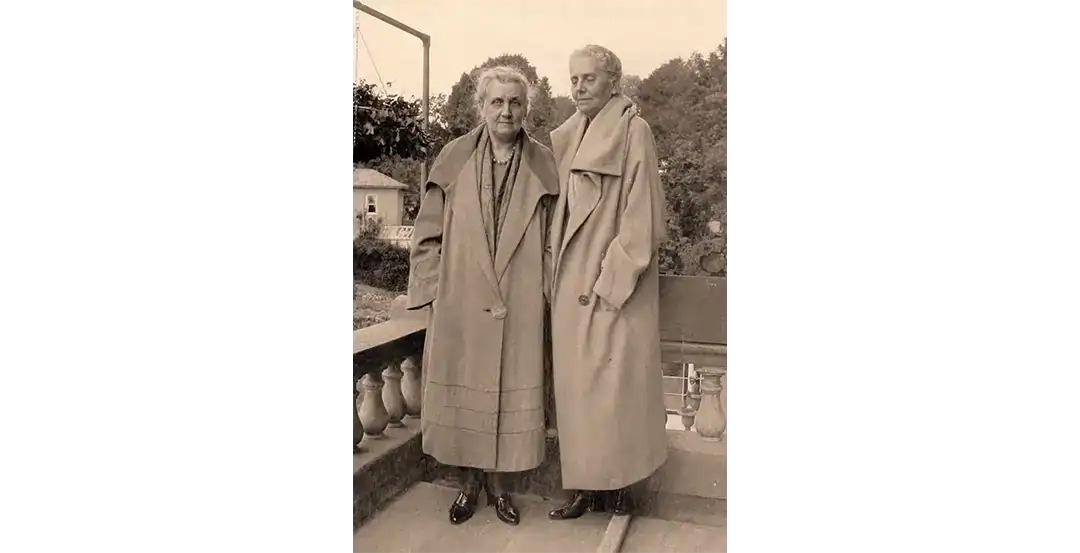


Of the many extraordinary lesbians who have marked history, we want to celebrate the woman whose birthday falls today (lucky her!) – and the reason Lesbian History Day is on 6th September: Jane Addams.
Jane Addams was born on 6th September 1860 in Cedarville, Illinois, into a prosperous and politically connected family.
Her father, John Huy Addams, was a state senator and a man of deep moral conviction – qualities that would profoundly shape his daughter’s worldview. The death of her mother when Jane was just two years old, and her own struggles with spinal illness during childhood, instilled in her an early awareness of vulnerability and suffering. These experiences planted the seeds of a life devoted to social justice.
After graduating from Rockford Female Seminary in 1881, Addams spent several years searching for direction. A transformative trip to Europe in 1887, during which she visited Toynbee Hall, a settlement house in London’s East End, crystallised her vision.
A settlement house was a community centre established in a poor urban area during the late 19th and early 20th centuries to provide social services, education, and healthcare to low-income residents and immigrants.
She would bring this model to America. In 1889, alongside her close companion Ellen Gates Starr, she co-founded Hull House in Chicago. It would become the most famous settlement house in the United States and serve as a blueprint for over 400 such centres in the country.
Hull House was far more than a charitable institution. It was a living experiment in democracy, community, and mutual aid.
Located in a neighbourhood teeming with immigrant families from Italy, Greece, Germany, Poland, and beyond, Hull House offered kindergartens, adult education classes, an art gallery, a public kitchen, a gymnasium, and a labour museum. At its peak, it served thousands of people each week.
But Addams’s ambitions extended well beyond the walls of Hull House. She used the settlement as a base from which to advocate for sweeping legislative reform: child labour laws, the eight-hour workday for women, factory safety regulations, juvenile courts, and workers’ compensation.
In 1931, she became the first American woman to receive the Nobel Peace Prize, recognised for her tireless work in international peace and social reform.
No account of Jane Addams’s life is complete without acknowledging the central relationship that sustained her for nearly four decades.
In 1890, Addams met Mary Rozet Smith, a young philanthropist from a wealthy Chicago family who had come to volunteer at Hull House. What began as a shared commitment to social work blossomed into a deep, devoted partnership that lasted until Smith’s death in 1934.
Their letters reveal an intimacy that transcends friendship. Addams wrote to Smith of missing her “more than I can tell,” and the two women shared a bed when travelling, referred to each other in terms of endearment, and built a domestic life together.
Historians have long debated how to categorise their relationship (much like many lesbians of the time) The language of their era did not offer the vocabulary we have today, but the emotional and domestic reality of their bond is unmistakable.
Smith was Addams’s anchor, her confidante, and her greatest source of personal happiness. In a world that offered women few models for lives outside of heterosexual marriage, Addams and Smith carved out a partnership of extraordinary depth and mutual devotion.
To celebrate Jane Addams without complication would be to do history (and the woman herself) a disservice. Like many progressive reformers of her era, Addams held some views that overlapped with the eugenics movement – a set of ideas, widely accepted at the time, about improving public health and society through better understanding of heredity.
Context matters enormously here. In the late nineteenth and early twentieth centuries, eugenic thinking was not a fringe belief; it was mainstream. It was taught in universities, endorsed by scientists, and embraced by reformers across the political spectrum, from Theodore Roosevelt to Alexander Graham Bell.
Progressive Era thinkers genuinely believed they were applying modern science to age-old social problems like poverty, disease, and inequality. The line between public health advocacy and eugenic reasoning was often blurry, and many well-intentioned people crossed it without fully grasping the implications.
Addams was no exception. While she never championed the movement’s most extreme positions, some of her language and assumptions about “fitness” and social improvement reflected the eugenic thinking that permeated her intellectual world (to be clear this belief was mostly linked to the “fitness” of sex workers to be mothers).
Her work at Hull House, though rooted in genuine compassion, occasionally carried paternalistic undertones about which communities needed guidance and what form that guidance should take.
It’s worth noting, however, that Addams was also a woman who consistently defied the conventions of her age. She fought for immigrant rights during waves of nativism, opposed World War I when pacifism was deeply unpopular (this is what earned her the nickname of the Most Dangerous Woman in America), and championed the poor when much of society insisted their suffering was their own fault.
That she did not fully interrogate eugenic assumptions reminds us that even the most courageous thinkers can have blind spots shaped by the intellectual currents around them. It’s not a reason to dismiss her, but it is a reason to engage with her legacy thoughtfully, recognising that progress is always a work in motion.
Jane Addams died on May 21st 1935, just a year after losing Mary Rozet Smith (at the time of her death Addams was bedridden and gravely ill, and the news of Rozet Smith’s passing was initially kept from her). She had reshaped American social policy, inspired generations of activists, and demonstrated that a life of purpose could also be a life of love.
But even great legacies are not monuments; they are living things, meant to be examined, questioned, and learned from. To honour Addams fully is to hold her brilliance and her blind spots in the same hand. It is to recognise that even the most visionary among us can be shaped by the assumptions of their age – and that the measure of progress is our willingness to see what they could not.
 https://www.lgbtinsurancenetwork.com/wp-content/uploads/2026/09/Jane-Addams-The-Most-Dangerous-Woman-in-America-featured-2.jpg
1080
1080
fletch
https://www.lgbtinsurancenetwork.com/wp-content/uploads/2021/03/Link-LGBTQ-Insurance-Network-logo-web-white.png
fletch2026-09-05 08:00:312026-09-05 14:43:41Jane Addams: The Most Dangerous Woman in America?
https://www.lgbtinsurancenetwork.com/wp-content/uploads/2026/09/Jane-Addams-The-Most-Dangerous-Woman-in-America-featured-2.jpg
1080
1080
fletch
https://www.lgbtinsurancenetwork.com/wp-content/uploads/2021/03/Link-LGBTQ-Insurance-Network-logo-web-white.png
fletch2026-09-05 08:00:312026-09-05 14:43:41Jane Addams: The Most Dangerous Woman in America? https://www.lgbtinsurancenetwork.com/wp-content/uploads/2026/08/Gluck-featured.png
1080
1080
fletch
https://www.lgbtinsurancenetwork.com/wp-content/uploads/2021/03/Link-LGBTQ-Insurance-Network-logo-web-white.png
fletch2026-08-13 08:26:522026-09-05 14:45:50GLUCK – THE ARTIST WHO REFUSED TO BE LABELLED
https://www.lgbtinsurancenetwork.com/wp-content/uploads/2026/08/Gluck-featured.png
1080
1080
fletch
https://www.lgbtinsurancenetwork.com/wp-content/uploads/2021/03/Link-LGBTQ-Insurance-Network-logo-web-white.png
fletch2026-08-13 08:26:522026-09-05 14:45:50GLUCK – THE ARTIST WHO REFUSED TO BE LABELLED https://www.lgbtinsurancenetwork.com/wp-content/uploads/2026/07/Ruth-Ellis-Featured.png
1080
1080
fletch
https://www.lgbtinsurancenetwork.com/wp-content/uploads/2021/03/Link-LGBTQ-Insurance-Network-logo-web-white.png
fletch2026-07-23 06:00:462026-09-05 14:54:46Ruth Ellis – A Beacon of Hope Across Generations
https://www.lgbtinsurancenetwork.com/wp-content/uploads/2026/07/Ruth-Ellis-Featured.png
1080
1080
fletch
https://www.lgbtinsurancenetwork.com/wp-content/uploads/2021/03/Link-LGBTQ-Insurance-Network-logo-web-white.png
fletch2026-07-23 06:00:462026-09-05 14:54:46Ruth Ellis – A Beacon of Hope Across Generations https://www.lgbtinsurancenetwork.com/wp-content/uploads/2026/06/Renee-Vivien-featured-side.png
1080
1080
fletch
https://www.lgbtinsurancenetwork.com/wp-content/uploads/2021/03/Link-LGBTQ-Insurance-Network-logo-web-white.png
fletch2026-06-10 08:11:402026-09-03 16:35:14Renée Vivien – Enigmatic Poetess of the Belle Époque
https://www.lgbtinsurancenetwork.com/wp-content/uploads/2026/06/Renee-Vivien-featured-side.png
1080
1080
fletch
https://www.lgbtinsurancenetwork.com/wp-content/uploads/2021/03/Link-LGBTQ-Insurance-Network-logo-web-white.png
fletch2026-06-10 08:11:402026-09-03 16:35:14Renée Vivien – Enigmatic Poetess of the Belle Époque https://www.lgbtinsurancenetwork.com/wp-content/uploads/2026/05/Florence-Nightingale-Featured.png
1080
1080
fletch
https://www.lgbtinsurancenetwork.com/wp-content/uploads/2021/03/Link-LGBTQ-Insurance-Network-logo-web-white.png
fletch2026-05-05 07:53:142026-09-03 16:35:21Florence Nightingale: The Lesbian with the Lamp?
https://www.lgbtinsurancenetwork.com/wp-content/uploads/2026/05/Florence-Nightingale-Featured.png
1080
1080
fletch
https://www.lgbtinsurancenetwork.com/wp-content/uploads/2021/03/Link-LGBTQ-Insurance-Network-logo-web-white.png
fletch2026-05-05 07:53:142026-09-03 16:35:21Florence Nightingale: The Lesbian with the Lamp? https://www.lgbtinsurancenetwork.com/wp-content/uploads/2026/04/Marie-Helen-featured-MH-2026.png
1080
1080
fletch
https://www.lgbtinsurancenetwork.com/wp-content/uploads/2021/03/Link-LGBTQ-Insurance-Network-logo-web-white.png
fletch2026-04-23 15:08:072026-09-05 14:42:14What is Lesbian History Day?
https://www.lgbtinsurancenetwork.com/wp-content/uploads/2026/04/Marie-Helen-featured-MH-2026.png
1080
1080
fletch
https://www.lgbtinsurancenetwork.com/wp-content/uploads/2021/03/Link-LGBTQ-Insurance-Network-logo-web-white.png
fletch2026-04-23 15:08:072026-09-05 14:42:14What is Lesbian History Day? https://www.lgbtinsurancenetwork.com/wp-content/uploads/2026/03/anne-lister-plaque.jpg
591
605
fletch
https://www.lgbtinsurancenetwork.com/wp-content/uploads/2021/03/Link-LGBTQ-Insurance-Network-logo-web-white.png
fletch2026-03-31 05:00:002026-09-03 16:35:39Anne Lister: the First Modern Lesbian?
https://www.lgbtinsurancenetwork.com/wp-content/uploads/2026/03/anne-lister-plaque.jpg
591
605
fletch
https://www.lgbtinsurancenetwork.com/wp-content/uploads/2021/03/Link-LGBTQ-Insurance-Network-logo-web-white.png
fletch2026-03-31 05:00:002026-09-03 16:35:39Anne Lister: the First Modern Lesbian?what it is, why it exists, and how you can help support and take part in it.
If you enjoyed this article, please consider joining Link for more great insights and events from the LGBTQ+ community
Diversity & Innovation: Perspectives from insurance industry leaders at Insurtech Insights Europe, 2026
If you enjoyed this article, please consider joining Link for more great insights and events from the LGBTQ+ community


 Insurance’s innovation problem starts with its talent pipeline