“Can I Dye My Hair at This Company?”
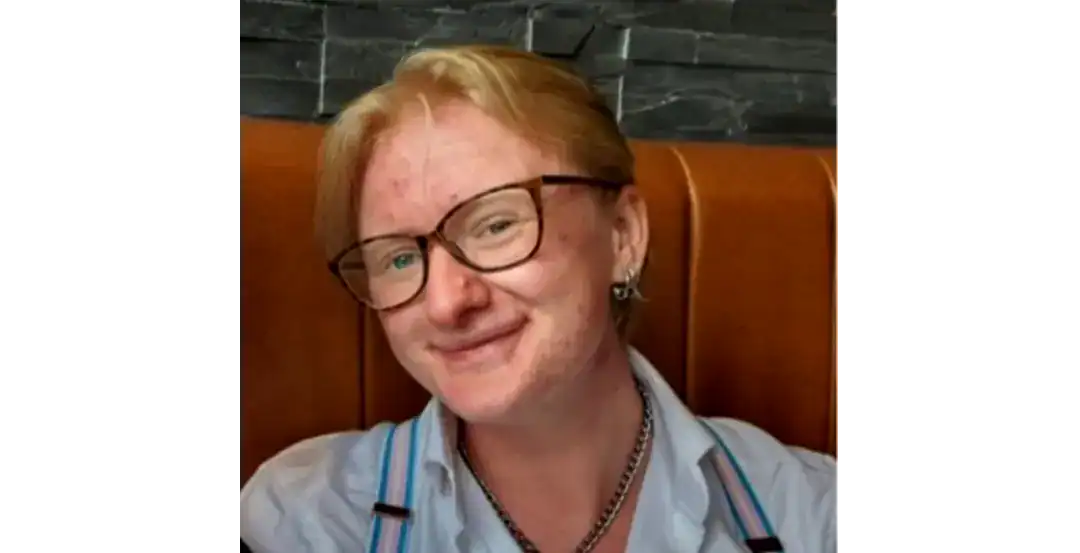


At their last insurer, Ros Fisher heard enough from senior management to know they couldn’t come out as non-binary/transmasc. Three years after moving to Munich Re, they were a week from top surgery when speaking to us – and open about what the company got right, and what still needs to be improved.
As a senior risk and compliance analyst, Ros knew they wouldn’t be able to be themselves at their previous employer because they’d run the assessment like an experienced risk analyst.
“I’d actively heard senior management saying things which were transphobic, so I was very aware that I couldn’t come out there,” Ros says. They couldn’t be open, hid tattoos, couldn’t dye their hair. They arrived at Munich Re therefore, “used to having to not be open about it.”
Their first question at interview: “Can I dye my hair at this company?”
Ros grins at the memory: “They looked at me like this was the weirdest thing they could possibly be asked – ‘Yes? Why would that be a problem? Obviously, that’s fine.’ Not that that’s a massive indicator, but I do think places with a less strict dress code are often like that, because people are a bit more open generally.”
For someone used to having to hide, the reaction was enough. A sign that they might have found a place they could be themselves. But, as with many of the stories and personal experiences in this series, coming out is often a process of continuous risk assessment. Ros had to test the waters.
“I didn’t come out immediately,” they clarify, explaining that at the time of the career move they were also socially transitioning in their private life – friends knew, family didn’t yet. It was a delicate time.
“I started having she/they in my e-signature and a little badge with that on. People weren’t weird about it.”
They pause before adding: “I do think there’s still the thing that if you give people the option, they pretty much never use ‘they’ for you – they default to what makes them more comfortable. That was mostly the case here as well. But I wanted to use just they/them eventually anyway, so I swapped to that, because my first interaction had been fine, and I’d been working here long enough, or was comfortable enough, to be able to actually advocate for myself. I knew the people around me well enough.”
What Ros has found overwhelming “is that people here at Munich Re genuinely mean very well. Even if they don’t understand or know stuff, people aren’t going to be actively unpleasant about things. So I was comfortable coming out fully then.”
The support was literally transformative: “While I’ve been here I started dressing differently, cut my hair, I started testosterone, and literally next week I’m getting top surgery. So they’ve had the whole gamut.”
How is the support for the surgery?
“Genuinely wonderful,” Ros says, citing the four weeks’ sick leave they’ll get to recover from top surgery. And there have been other signs of support too.
“I was in a meeting in the past where someone misgendered me, and a senior executive was in that meeting, and he messaged me afterwards. He said: ‘I didn’t want to do anything because I don’t know what was best, but if there’s anything you want me to do next time, let me know.’”
Unfortunately, for all the support Ros feels and has received, there was one key thing missing:
“I got my gender dysphoria consultation and my testosterone consultation free and that made a massive difference – but I would not have had it through this work. We don’t have the gender pathway at Munich Re. It’s one of the things I’ve been fairly vocal about.”
Ros actually got these consultations through their partner’s health insurance at another company, without which their experience would have been much more difficult, time consuming, and costly. It’s a powerful example of where even companies with the best intentions can still have blind spots.
“Policy-wise, I think we could be better,” Ros reflects. “It upsets me.”
There are other pressures and subtle disappointments for trans and non-binary people even in genuinely supportive workplaces.
“Within Munich Re, there aren’t many barriers to coming out, but there aren’t many of us who are visibly out. So you still have the thing of: am I going to be effectively the only person who’s open about this? Will people see me differently? Will they treat me differently? I think often the answer is no, but it’s still quite daunting, especially when I was first deciding to do it. It’s a big leap to take.”
The process of coming out never stops, Ros adds, because their job involves constant interactions with new people. On top of this is the pressure to educate others on gender queerness just by being one of the few in that workplace: “and therefore whatever I was saying might be the only thing these people hear about that…
“I really appreciate that people did actually want to talk and understand, but there is the pressure of wanting to represent this group well and say the right things. That can be quite daunting.”
As Ros says, it’s daunting even when the pressure comes from a good place, “which within Munich Re it genuinely does. I generally say to people: I’m always happy to talk about stuff if you genuinely want to, but sometimes I might not be able to answer right then.”
And then there’s the question of how to conduct oneself in an environment that doesn’t know how to treat you and often forces you to make choices that can be uncomfortable.
“The classic: here in London we now have gender-neutral toilets. Up in Manchester, where I was this week, they didn’t. And in our Munich office, they don’t. So that’s an immediate choice you have to make about what’s going to be acceptable – not just from a legal or guidance perspective, but from a ‘this is my workplace, and I’m also representing my other workplace at this workplace’ perspective.”
No wonder it can be exhausting – and this in a company that largely succeeds at being accepting!
With so much angst and uncertainty about how to act and how others will react, Ros’ advice is practical, emphasising self-care, caution, and self-advocacy where possible.
“I would say it’s okay to take your time with it. I know it can sometimes feel there’s a pressure that once you come out a bit, you’ve got to go the whole way. But you don’t need to do anything that makes you feel uncomfortable.”
What if you work in a hostile environment, as Ros did?
“If you have the ability to job hunt, I do think it’s worth it for your peace of mind, because when you do feel more comfortable to be yourself, it is like having a weight lifted from you.”
In the final analysis, wherever you are, “you can come out a little bit first – to a couple of people you trust, so you’ve got some people you can be more open with and who you feel might back you up as well.”
 https://www.lgbtinsurancenetwork.com/wp-content/uploads/2026/10/Colin-Masson-Munich-RE-Featured.webp
1080
1080
fletch
https://www.lgbtinsurancenetwork.com/wp-content/uploads/2021/03/Link-LGBTQ-Insurance-Network-logo-web-white.png
fletch2026-10-14 13:26:512026-10-14 13:26:51There’s a Level of Trust You Bring by Being Open
https://www.lgbtinsurancenetwork.com/wp-content/uploads/2026/10/Colin-Masson-Munich-RE-Featured.webp
1080
1080
fletch
https://www.lgbtinsurancenetwork.com/wp-content/uploads/2021/03/Link-LGBTQ-Insurance-Network-logo-web-white.png
fletch2026-10-14 13:26:512026-10-14 13:26:51There’s a Level of Trust You Bring by Being Open https://www.lgbtinsurancenetwork.com/wp-content/uploads/2026/10/Ros-Fisher-Munich-RE-Featured.webp
1080
1080
fletch
https://www.lgbtinsurancenetwork.com/wp-content/uploads/2021/03/Link-LGBTQ-Insurance-Network-logo-web-white.png
fletch2026-10-14 13:18:342026-10-14 14:36:08Can I Dye My Hair at This Company?
https://www.lgbtinsurancenetwork.com/wp-content/uploads/2026/10/Ros-Fisher-Munich-RE-Featured.webp
1080
1080
fletch
https://www.lgbtinsurancenetwork.com/wp-content/uploads/2021/03/Link-LGBTQ-Insurance-Network-logo-web-white.png
fletch2026-10-14 13:18:342026-10-14 14:36:08Can I Dye My Hair at This Company? https://www.lgbtinsurancenetwork.com/wp-content/uploads/2026/10/Coming-Out-Lockton-Featured.png
1254
1254
fletch
https://www.lgbtinsurancenetwork.com/wp-content/uploads/2021/03/Link-LGBTQ-Insurance-Network-logo-web-white.png
fletch2026-10-13 09:38:252026-10-14 13:05:26Unless I Paid Them £1 Million, They Would Tell my Family and my Colleagues at Work That I Was Gay!
https://www.lgbtinsurancenetwork.com/wp-content/uploads/2026/10/Coming-Out-Lockton-Featured.png
1254
1254
fletch
https://www.lgbtinsurancenetwork.com/wp-content/uploads/2021/03/Link-LGBTQ-Insurance-Network-logo-web-white.png
fletch2026-10-13 09:38:252026-10-14 13:05:26Unless I Paid Them £1 Million, They Would Tell my Family and my Colleagues at Work That I Was Gay! https://www.lgbtinsurancenetwork.com/wp-content/uploads/2026/10/6-Maisie-McCarthy-and-Laurence-Peck-Featured.png
1254
1254
fletch
https://www.lgbtinsurancenetwork.com/wp-content/uploads/2021/03/Link-LGBTQ-Insurance-Network-logo-web-white.png
fletch2026-10-02 08:59:082026-10-02 12:22:12Once That Gets Posted, That’s It Now…
https://www.lgbtinsurancenetwork.com/wp-content/uploads/2026/10/6-Maisie-McCarthy-and-Laurence-Peck-Featured.png
1254
1254
fletch
https://www.lgbtinsurancenetwork.com/wp-content/uploads/2021/03/Link-LGBTQ-Insurance-Network-logo-web-white.png
fletch2026-10-02 08:59:082026-10-02 12:22:12Once That Gets Posted, That’s It Now… https://www.lgbtinsurancenetwork.com/wp-content/uploads/2026/10/5-Dr-Keshier-Randolph-and-Ryan-Suby-Featured.png
1254
1254
fletch
https://www.lgbtinsurancenetwork.com/wp-content/uploads/2021/03/Link-LGBTQ-Insurance-Network-logo-web-white.png
fletch2026-10-02 08:50:502026-10-02 12:21:12You Don’t Need the World’s Permission to Be Who God Created You to Be
https://www.lgbtinsurancenetwork.com/wp-content/uploads/2026/10/5-Dr-Keshier-Randolph-and-Ryan-Suby-Featured.png
1254
1254
fletch
https://www.lgbtinsurancenetwork.com/wp-content/uploads/2021/03/Link-LGBTQ-Insurance-Network-logo-web-white.png
fletch2026-10-02 08:50:502026-10-02 12:21:12You Don’t Need the World’s Permission to Be Who God Created You to Be https://www.lgbtinsurancenetwork.com/wp-content/uploads/2026/10/4.-Sean-Bracebridge.webp
1080
1080
fletch
https://www.lgbtinsurancenetwork.com/wp-content/uploads/2021/03/Link-LGBTQ-Insurance-Network-logo-web-white.png
fletch2026-10-02 08:49:292026-10-02 12:19:42I’ve Never Really Come Out
https://www.lgbtinsurancenetwork.com/wp-content/uploads/2026/10/4.-Sean-Bracebridge.webp
1080
1080
fletch
https://www.lgbtinsurancenetwork.com/wp-content/uploads/2021/03/Link-LGBTQ-Insurance-Network-logo-web-white.png
fletch2026-10-02 08:49:292026-10-02 12:19:42I’ve Never Really Come Out https://www.lgbtinsurancenetwork.com/wp-content/uploads/2026/10/3-Pedro-Chamorro-Llanc-and-Steve-Bayless-Featured.png
1254
1254
fletch
https://www.lgbtinsurancenetwork.com/wp-content/uploads/2021/03/Link-LGBTQ-Insurance-Network-logo-web-white.png
fletch2026-10-02 08:48:312026-10-02 12:20:18Seeing Other People Being Themselves Made a Big Difference
https://www.lgbtinsurancenetwork.com/wp-content/uploads/2026/10/3-Pedro-Chamorro-Llanc-and-Steve-Bayless-Featured.png
1254
1254
fletch
https://www.lgbtinsurancenetwork.com/wp-content/uploads/2021/03/Link-LGBTQ-Insurance-Network-logo-web-white.png
fletch2026-10-02 08:48:312026-10-02 12:20:18Seeing Other People Being Themselves Made a Big Difference https://www.lgbtinsurancenetwork.com/wp-content/uploads/2026/10/2-Drew-Hutchinson-and-Mark-Osborne-Featured.png
1254
1254
fletch
https://www.lgbtinsurancenetwork.com/wp-content/uploads/2021/03/Link-LGBTQ-Insurance-Network-logo-web-white.png
fletch2026-10-02 08:47:322026-10-02 12:23:16For Years I Feared How People Would React if They Knew
https://www.lgbtinsurancenetwork.com/wp-content/uploads/2026/10/2-Drew-Hutchinson-and-Mark-Osborne-Featured.png
1254
1254
fletch
https://www.lgbtinsurancenetwork.com/wp-content/uploads/2021/03/Link-LGBTQ-Insurance-Network-logo-web-white.png
fletch2026-10-02 08:47:322026-10-02 12:23:16For Years I Feared How People Would React if They Knew https://www.lgbtinsurancenetwork.com/wp-content/uploads/2026/10/1-Vanessa-Horne-and-Geoff-Lealan-Featured.webp
1080
1080
fletch
https://www.lgbtinsurancenetwork.com/wp-content/uploads/2021/03/Link-LGBTQ-Insurance-Network-logo-web-white.png
fletch2026-10-02 08:45:162026-10-02 12:15:41You’ll Know When You’re Ready
https://www.lgbtinsurancenetwork.com/wp-content/uploads/2026/10/1-Vanessa-Horne-and-Geoff-Lealan-Featured.webp
1080
1080
fletch
https://www.lgbtinsurancenetwork.com/wp-content/uploads/2021/03/Link-LGBTQ-Insurance-Network-logo-web-white.png
fletch2026-10-02 08:45:162026-10-02 12:15:41You’ll Know When You’re ReadyIf you enjoyed this article, please consider joining Link for more great insights and events from the LGBTQ+ community


 There’s a Level of Trust You Bring by Being Open